US models · Checked · Researched recommendations
The ECHO RB-60 is our starting pick for regular lawn care: it combines pneumatic tires, a foot-operated edge deflector and a verified hopper rating at a competitive listed price. For a small, smooth lawn and a tighter budget, start with the Scotts Mini. The EarthWay and Elite offer different storage and control tradeoffs, compared below.
As an Amazon Associate I earn from qualifying purchases. Amazon buttons are paid links. Manufacturer, Home Depot and Tractor Supply links are ordinary references. We researched these products; we have not tested them hands-on. Our disclosure
Which broadcast spreader should I buy?
Compare the actual controls and wheels before the advertised coverage. All four have an edge-control feature, but operating a deflector with your foot feels different from reaching to the hopper. Try the shutoff and handle grip in a store if possible, especially if holding a lever is uncomfortable.
| Model / price snapshot | Capacity | Wheels | Edge control |
|---|---|---|---|
| ECHO RB-60Our pick for regular lawn care$149.99 · ECHO MSRP | 60 lb rated | 10-inch pneumatic | Foot-operated side deflector |
| Scotts EdgeGuard MiniBudget pick for a small lawn$72.99 · Scotts direct price | Up to 5,000 sq ft* | Hard plastic wheels | Right-side EdgeGuard |
| EarthWay 2600A-PlusCompact pick with pneumatic tires$177.99 · EarthWay direct price | 40 lb rated | 9-inch pneumatic | Side-spread control beneath the hopper |
| Scotts ElitePick for never-flat tires and dual rotors$169.99 · Tractor Supply listing | Up to 20,000 sq ft* | 10-inch foam-filled | Right-side EdgeGuard |
USD before tax and shipping; sources are linked in each card. ECHO is MSRP, not a retailer quote. Prices and local stock can change. *Scotts’ area claims depend on the product; they are not pound capacities.
Four fertilizer spreaders for different priorities
How we chose: this comparison focuses on US walk-behind broadcast spreaders for home lawns. We checked manufacturer specifications, price sources, storage, edge controls and current support terms, then calculated where hopper capacity changes refill counts. These four cover distinct budget and wheel choices. Recommendations reflect those documented features; we have no measured ranking of spread uniformity or durability.
ECHO RB-60
$149.99ECHO MSRP
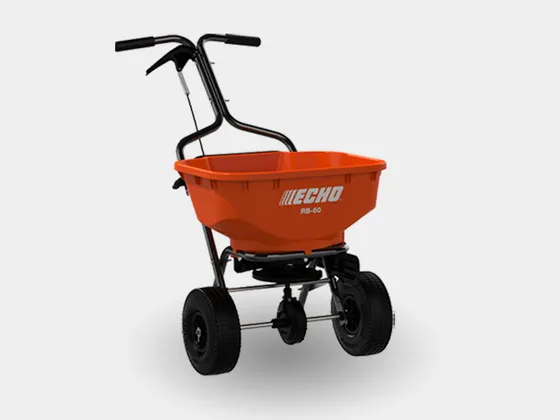
The strongest starting choice here for regular feeding: pneumatic tires, a 60 lb hopper rating and a foot-operated side deflector at a lower listed price than the EarthWay or Elite. The deflector is useful when your route alternates between open lawn and sidewalks; the extra capacity helps when a heavier application would otherwise require a stop.
Reasons to choose something else: The assembled frame needs storage space, and a full hopper can be more weight than you want to push. If you only need a small load on a smooth lawn, the Mini may be enough. Load only what you can control.
The displayed price is ECHO’s MSRP; check the linked Home Depot listing for the actual delivered price. Local service availability is worth checking before ordering.
- Storage
- T-handle; allow space for the assembled frame.
- Consumer coverage
- 5-year consumer warranty; commercial coverage is 90 days. Current terms.
Scotts EdgeGuard Mini
$72.99Scotts direct price
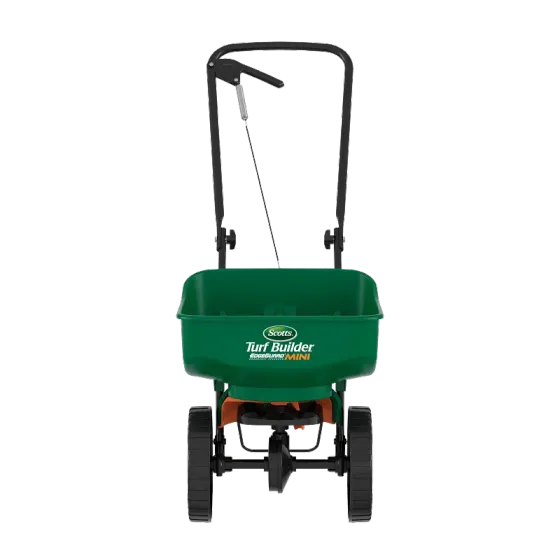
The least expensive of these four at the checked prices, and a sensible choice for occasional feeding on a small, mostly smooth lawn. The compact hopper and folding handle help in a crowded shed. It arrives assembled; unfold and secure the handle before use.
Reasons to choose something else: Small hard wheels are the main compromise on a bumpy route. For narrow strips surrounded by beds, consider a drop spreader instead. The Mini’s factory calibration still needs checking with your actual product and walking pace.
Scotts publishes up to 5,000 sq ft of its products, without a pound rating on the cited page. The snapshot is Scotts’ direct price; compare retailers before paying it.
- Storage
- Fold-down handle; compact hopper.
- Consumer coverage
- No mechanical warranty; No-Quibble refund requests within 1 year. Current terms.
EarthWay 2600A-Plus
$177.99EarthWay direct price
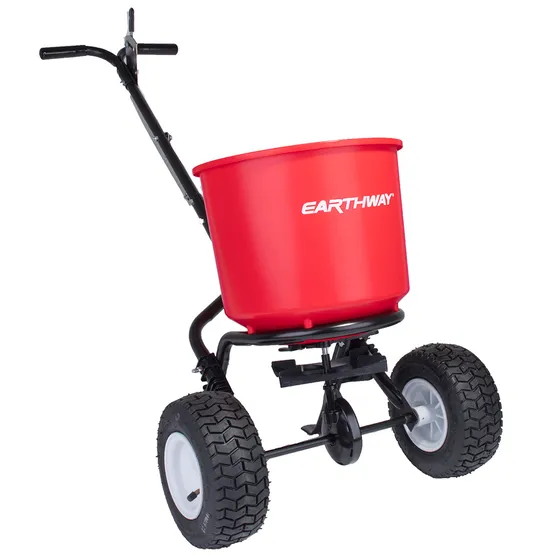
An alternative for buyers who prefer a smaller hopper while retaining pneumatic tires and a solid linkage to the flow control. Its 40 lb rating and low-profile layout suit someone who has no use for the ECHO’s extra capacity. EarthWay provides model-specific manuals and parts resources.
Reasons to choose something else: It costs more than the ECHO MSRP while holding less, so try the handle position and check the assembled footprint first. The side-spread control is beneath the hopper; consider whether reaching it suits your route and mobility.
The optional rain cover is sold separately. Use the current warranty below when comparing sellers; older buying guides quote different coverage.
- Storage
- Low-profile hopper; check assembled fit.
- Consumer coverage
- 1-year limited manufacturer defect warranty. Current terms.
Scotts Elite
$169.99Tractor Supply listing
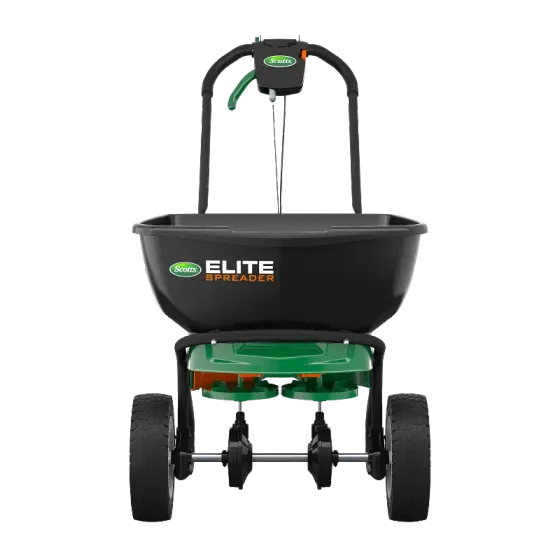
Choose the Elite when you want larger foam-filled tires without pressure checks, plus a handle that folds for storage. It combines dual rotors with right-side EdgeGuard. Scotts bags provide model-specific settings as a starting point for calibration.
Reasons to choose something else: A larger price and dual rotors do not establish better measured uniformity. If the Mini already rolls comfortably and applies your product evenly, keep it. Check the Elite’s effective lane spacing with your material before relying on its advertised spread width.
The snapshot is Tractor Supply’s listing; the Amazon button may show a different price. Scotts describes capacity as up to 20,000 sq ft, without a pound rating on the cited page.
- Storage
- Handle folds for storage.
- Consumer coverage
- No mechanical warranty; No-Quibble refund requests within 1 year. Current terms.
Displayed prices are source snapshots, not live Amazon prices. The Amazon links were checked against the Mini and Elite product titles and model numbers. Retail packaging suffixes can differ; confirm the selected model, seller, included parts and delivery price at checkout.
ECHO RB-60 vs. EarthWay 2600A-Plus: which should I choose?
Favor the ECHO on the checked prices unless the EarthWay’s layout fits you better. Both have pneumatic tires. ECHO offers the larger rated hopper and a foot-operated edge deflector; EarthWay offers a smaller, low-profile hopper and solid flow-control linkage. Compare the actual handle reach, edge-control access and storage fit before paying extra for the EarthWay.
For the 10,000 sq ft, 3 lb-per-1,000 example below, either carries the 30 lb application in one load if it fits. ECHO’s extra capacity earns its place when you regularly need more than the EarthWay’s usable fill and can comfortably push that weight. A smaller batch in the ECHO is also an option; you do not have to fill its hopper.
Scotts Mini vs. Elite: is the upgrade worth it?
Keep the Mini for a small, smooth lawn; consider the Elite when the wheel and hopper differences solve a recurring problem. Both have folding handles and right-side EdgeGuard. The Elite’s larger foam-filled tires are its clearest practical distinction here. Its larger hopper may also reduce stops, but Scotts’ area claims do not tell us how many pounds of your product either model holds.
If refills are your reason to upgrade, weigh the usable amount in your current spreader and enter it in the load estimator. Confirm what the replacement holds with that material before buying. If stripes are the problem, check the rate and spread pattern first.
How big a fertilizer spreader do I need?
Calculate the product weight for your application, then decide how much to load at once. Lawn area alone does not specify a hopper size. Seed, dense fertilizer and lightweight granules can occupy different volumes at the same weight. You may reach the hopper’s fill line before its pound rating.
Here is the refill comparison for the two models with verified pound ratings. It assumes the product fits, you can comfortably push the rated load, and you treat the whole lawn once at the stated total rate.
| Lawn / product rate | Product needed | 40 lb load EarthWay | 60 lb load ECHO |
|---|---|---|---|
| 5,000 sq ft3 lb / 1,000 sq ft | 15 lb | 0 refills | 0 refills |
| 10,000 sq ft3 lb / 1,000 sq ft | 30 lb | 0 refills | 0 refills |
| 20,000 sq ft3 lb / 1,000 sq ft | 60 lb | 1 refill | 0 refills |
| 10,000 sq ft6 lb / 1,000 sq ft | 60 lb | 1 refill | 0 refills |
Computed by our spreader engine: area × product rate ÷ 1,000; round product ÷ usable load up to whole loads, then subtract the initial fill. Zero refills still means loading once. The rates are illustrative, not instructions for any product. Deliberately splitting an application into separate sessions may add fills.
Will a larger hopper save me a refill?
Use the amount that actually fits and that you can comfortably push, within the spreader’s rating. For a model sold only by square-foot coverage, weigh a suitable fill or confirm a pound limit with the maker.
Need the product amount first? Use the fertilizer calculator. Ready to spread? Measure your application with the spreader-calibration calculator.
Are pneumatic tires worth paying for?
Buy wheels for the route you actually walk. ECHO and EarthWay use air-filled tires; the Elite’s foam-filled tires avoid punctures and pressure checks; the Mini uses hard plastic wheels. Air-filled tires offer cushioning over uneven ground, but inflation becomes another maintenance job. A smooth, small lawn gives you less reason to pay for that tradeoff.
Try a representative route with the weight you expect to carry. Roots, soft ground, narrow turns and slopes matter more than a generic “all terrain” description. A larger hopper increases what you can load; it does not require filling to the brim. If control becomes awkward, reduce the load. None of these picks comes with a slope-safety rating in this comparison.
Does an edge guard keep fertilizer out of beds?
It helps control one side of the pattern; it does not create a sealed boundary. Check which side is blocked and plan your route accordingly. ECHO’s foot deflector, EarthWay’s hopper control and Scotts’ EdgeGuard solve the same buying need through different mechanisms.
A guard can change the distribution near an edge. Follow the spreader’s instructions for that mode, return it to normal for open-lawn passes, and check for granules beyond the lawn. Recover spills and sweep stray fertilizer back onto the intended treatment area as the product directs; do not hose it into the street. If the lawn is mostly narrow strips beside sensitive beds, a drop spreader may make placement easier.
Should I buy a broadcast, drop, handheld or tow-behind spreader?
Broadcast is the useful starting point for an open lawn: a rotating disc spreads across a wider swath than the machine itself. Virginia Cooperative Extension’s spreader guide distinguishes this from a drop spreader, which places material directly beneath its hopper and suits confined areas.
- Drop: consider it for a narrow lawn or intricate borders. Placement is easier to see, but gaps and excessive overlap between passes still create uneven applications.
- Handheld: useful for small patches and a light total load. Compare wrist comfort, shutoff and repeatability before buying a wheeled machine you cannot store.
- Tow-behind: consider it for a large, open property when you already have a compatible towing machine. Check hitch fit, access, turning room, slope limits and whether you can operate the shutoff from the seat.
There is no universal acreage boundary that makes one design correct. A broken-up lawn with gates and beds can favor a push spreader even when a neighboring open property favors towing. Measure the gate opening and the equipment’s assembled width before ordering.
Will a better spreader fix stripes in my lawn?
Find out whether the problem is equipment, flow or overlap before replacing it. Repeated bands can come from inconsistent lane spacing, a changing pace, leaving edge control engaged, or a gate that does not open and close reliably. A new spreader will not correct the wrong application rate.
Check that the hopper is clean, the granules are dry enough for the product’s instructions, the linkage moves freely and the spinner turns as intended. Then run a measured strip and inspect the distribution across it. The calibration tool separates the pounds applied from the uniformity of the pattern. Replace damaged equipment or an uncontrollable mechanism; do not diagnose a whole brand from a stripe.
If your existing spreader can deliver a repeatable rate and pattern, keeping it may be the best purchase decision. Put the money toward a reliable scale, or a soil test if you do not yet know what the lawn needs.
Can I use the same spreader for seed, lime and ice melt?
Check both the material label and the exact spreader manual. These are granular-material machines, not substitutes for a compost roller or a topsoil spreader. Powder, damp material and bulky organic matter can bridge or clog a hopper. A pelletized product may behave very differently from its powdered equivalent.
Do not carry a setting from fertilizer to seed, even when the required pounds happen to match. Granule shape, density and flow change the output. Use the grass-seed calculator for the quantity, then check the spreader with that seed. For ice melt, verify the permitted material and any required adjustments first; clean and dry the machine according to its manual before storage.
What should I check before ordering?
- Complete delivered price: compare shipping, tax, included covers and any edge-control accessories. A manufacturer MSRP and a retailer promotion are different kinds of price.
- Storage and assembly: measure where the machine will live. Check handle folding, clearance and the actual assembly instructions rather than relying on a small product photo.
- Parts and support: look for the manual, model-specific parts and a reachable service route. ECHO publishes technical documents; EarthWay lists manuals and parts resources. Keep the exact model and receipt.
- Return and warranty terms: check the current seller and manufacturer terms. A satisfaction guarantee, a defect warranty and a promise about commercial use cover different things.
After delivery, check the assembly and controls before filling. Establish your own measured test-strip rate with the actual product. The setting printed on a bag is a starting point; a universal setting-conversion chart would imply precision that this equipment and these materials do not support.
Research and sources: Manufacturer specification and image links appear in each card; prices and consumer-coverage summaries were checked on November 22, 2026. Calibration principles: Virginia Cooperative Extension, Calibrating Your Lawn Spreader (430-017). Load comparisons use the stated product rates and usable fills. Product photographs are manufacturer images.